
February 13
The saints and feasts remembered on February 13, each with a short life, a Bible passage and a prayer.

Apollos
Eloquent preacher who let Priscilla and Aquila teach him more fully
Apollos was a Jew from Alexandria in Egypt who became a Christian teacher in the 50s AD. The Book of Acts calls him eloquent and well versed in the Scriptures. Arriving in Ephesus, he already spoke boldly about Jesus, though he knew only the baptism of John. Priscilla and Aquila, a tentmaking couple, heard him in the synagogue, took him aside and explained the way of God more accurately. The gifted speaker accepted their correction.
He then went to Corinth, where he helped the believers and argued publicly from the Scriptures that Jesus was the Messiah. His success had an awkward side: some Corinthians said “I belong to Apollos” against followers of Paul. Paul answered that he had planted, Apollos had watered, but God gave the growth. When Paul later urged him to return to Corinth, Apollos declined for the time being.
Little else is known; the idea that he wrote Hebrews is only a guess. Christians remember him as a brilliant teacher who stayed teachable.
What then is Apollos? And what is Paul? They are servants through whom you believed, as the Lord has assigned to each his role. I planted the seed and Apollos watered it, but God made it grow. So neither he who plants nor he who waters is anything, but only God, who makes things grow.
1 Corinthians 3:5–7 · BSB
A prayer
God of all wisdom, you gave Apollos a gift for teaching your Word and the humility to learn from others. Give us open hearts, ready to be corrected and eager to share the good news of Jesus, so that we seek not our own name but the growth that comes from you alone. Amen.
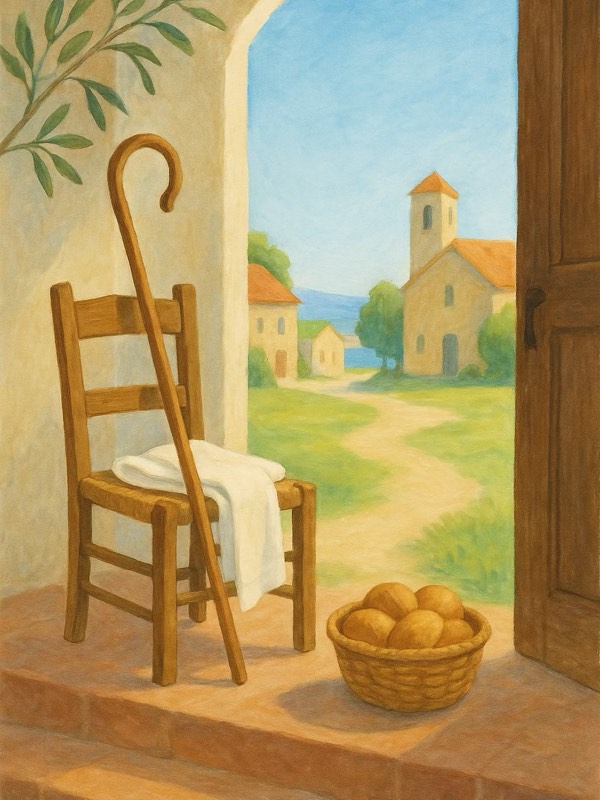
Saint Fulcran of Lodève
Bishop of Lodève for over fifty years who fed the poor and rebuilt churches
Fulcran lived in southern France in the tenth century. He came from a noble family of the Lodève area and was made bishop of that small city in 949. He would lead it until his death in 1006, more than half a century.
Those were rough years, with weak rulers, local violence and frequent hunger. Fulcran is remembered for using the Church’s wealth for others: feeding the poor in times of famine, caring for the sick, restoring ruined churches and supporting monasteries. He is also said to have refused to sell church offices, a common abuse at the time. Most of what we know comes from a Life written some three centuries after his death by a later bishop of Lodève, so some details are uncertain.
His people honoured him soon after he died, and the cathedral of Lodève still bears his name. He is remembered as a pastor who stayed with one flock for a lifetime and served it faithfully.
Be shepherds of God’s flock that is among you, watching over them not out of compulsion, but because it is God’s will; not out of greed, but out of eagerness; not lording it over those entrusted to you, but being examples to the flock.
1 Peter 5:2–3 · BSB
A prayer
Faithful God, you gave Fulcran to the people of Lodève as a patient shepherd who fed the hungry and rebuilt your house through long and troubled years. Make us steady in the work you give us, generous with what we have, and faithful to the people entrusted to our care, through Jesus Christ our Lord. Amen.
The lives are written with AI help from public-domain histories and checked before publishing; the prayers are ours. Bible quotations are from the Berean Standard Bible (BSB), in the public domain. How we write.