
October 19
The saints and feasts remembered on October 19, each with a short life, a Bible passage and a prayer.

Saints John de Brébeuf, Isaac Jogues and Companions
Six Jesuit priests and two lay helpers killed in mission lands, 1642–1649
In the 1630s and 1640s, French Jesuit missionaries travelled to New France to live among the Wendat (Huron) people near Georgian Bay, in what is now Ontario. John de Brébeuf spent years learning their language, wrote a grammar of it, and tried to explain the Gospel in words and images the Wendat could understand. Isaac Jogues worked among them too.
It was a dangerous time. Epidemics brought from Europe were killing thousands, and many blamed the missionaries. War raged between the Wendat and the Haudenosaunee (Iroquois). In 1642 Jogues was captured by Mohawks and tortured, losing parts of several fingers. He escaped, reached France, and then chose to go back. He was killed in 1646 near present-day Auriesville, New York. Brébeuf died under torture in 1649.
Eight men in all, six priests and two lay helpers, were killed between 1642 and 1649. Canonised in 1930, they are remembered for staying with a people they had come to love, even at great risk.
Truly, truly, I tell you, unless a kernel of wheat falls to the ground and dies, it remains only a seed; but if it dies, it bears much fruit. Whoever loves his life will lose it, but whoever hates his life in this world will keep it for eternal life.
John 12:24–25 · BSB
A prayer
Faithful God, you led John de Brébeuf, Isaac Jogues and their companions across the ocean to share the Gospel, and you gave them patience to learn, courage to return and strength to give their lives. Make us generous in serving others, respectful of every people, and steadfast when following you is costly. Amen.

Saint Paul of the Cross
Founded the Passionists to preach the suffering and love of Christ crucified
Paolo Francesco Danei was born in 1694 in Ovada, in northern Italy, into a merchant family that had little money. As a young man he felt drawn to prayer and to a life centred on Jesus’ passion. In 1720 his bishop gave him a plain black tunic, and he spent forty days alone writing a rule for a new community.
With his brother John Baptist he lived as a hermit, nursed the sick in a Roman hospital, and in 1727 was ordained a priest. Growth was slow: early companions left, and the Rule was not approved until 1741. Paul spent decades preaching parish missions in poor rural areas, guided many people through letters, of which more than two thousand survive, and in 1771 founded Passionist nuns. He also went through long years of inner darkness in prayer.
He died in Rome in 1775. His Passionists still preach the cross as the clearest sign of God’s love.
But as for me, may I never boast, except in the cross of our Lord Jesus Christ, through which the world has been crucified to me, and I to the world.
Galatians 6:14 · BSB
A prayer
God of mercy, you led Paul of the Cross to find in the passion of your Son the measure of your love, and to preach it to the poor. Keep the cross before our eyes, steady us when prayer feels dark, and make us gentle with all who suffer, through Jesus Christ our Lord. Amen.
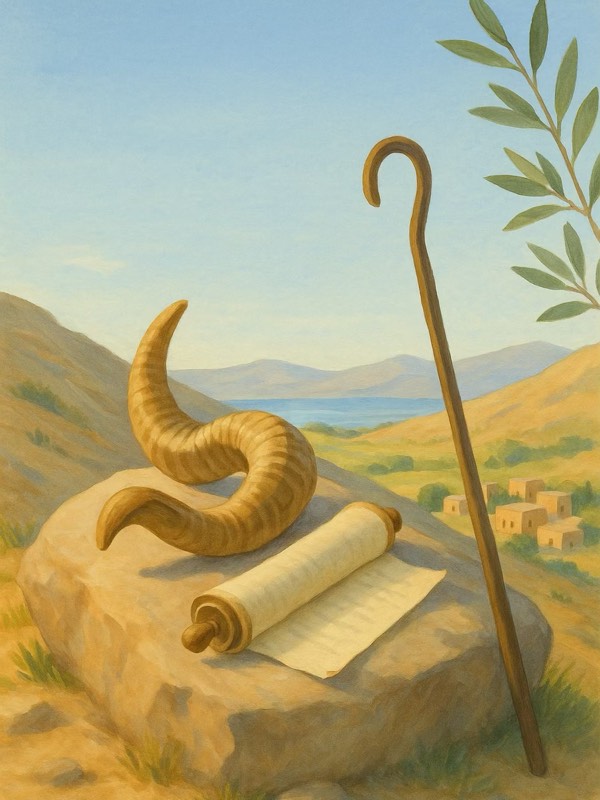
Saint Joel
Prophet who urged God’s people to tear their hearts, not their clothes
Joel was a prophet in Judah, known to us only through the short biblical book that bears his name. It tells us he was the son of Pethuel. Scholars still disagree about when he lived; suggestions span several centuries, though many place him after the return from exile in Babylon.
His book opens with a disaster: swarms of locusts stripping fields and vines, until even the grain offerings at the Temple ran short. Joel describes the insects like an invading army. He saw the crisis as a summons to turn back to God, and called everyone to fast and pray: the elderly, nursing babies, even a bride and groom on their wedding day. God, he said, wants torn hearts rather than torn clothes.
Joel also promised a day when God would pour out his Spirit on all people, young and old, servants included. At Pentecost, Peter quoted these words to explain what was happening, and many churches still read Joel at the start of Lent.
“Yet even now,” declares the LORD, “return to Me with all your heart, with fasting, weeping, and mourning.” So rend your hearts and not your garments, and return to the LORD your God. For He is gracious and compassionate, slow to anger, abounding in loving devotion. And He relents from sending disaster.
Joel 2:12–13 · BSB
A prayer
God of mercy, you sent your prophet Joel to call your people back to you in a time of loss, and promised to pour out your Spirit on all. Turn our hearts to you, not only our outward signs, and fill us with your Spirit, that young and old may serve you gladly. Through Jesus Christ our Lord. Amen.
The lives are written with AI help from public-domain histories and checked before publishing; the prayers are ours. Bible quotations are from the Berean Standard Bible (BSB), in the public domain. How we write.