
November 22
The saints and feasts remembered on November 22, each with a short life, a Bible passage and a prayer.
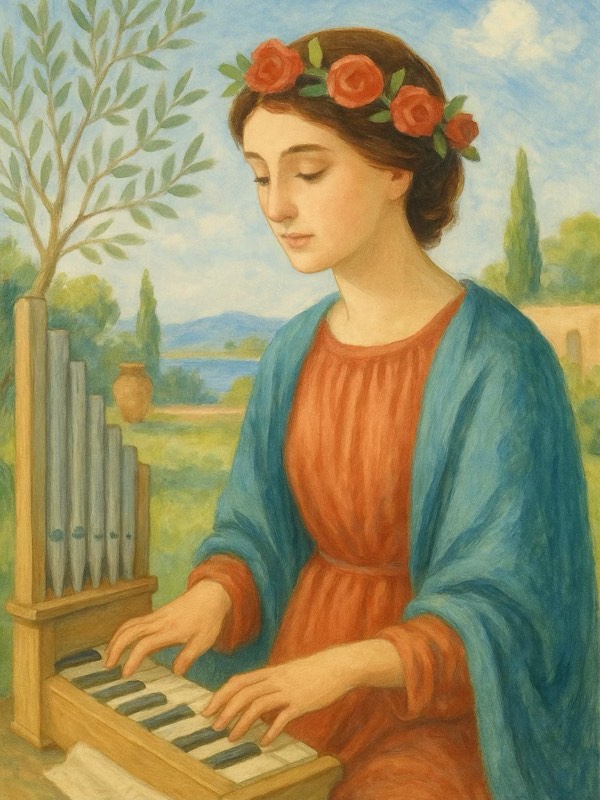
Saint Cecilia
Roman martyr whose story made her the patron saint of musicians
Cecilia was a Christian woman of Rome who died for her faith, probably in the third century, though the exact date is unknown. Very little about her is certain. Her name, however, was honoured early. A church in Rome’s Trastevere district carried it by the fifth century, and she is named in the ancient Roman eucharistic prayer.
Most of her story comes from an account written around the late fifth century, long after her death, and much of it is legend. It says she came from a noble family, had promised her life to God, and was married against her wishes to a young man named Valerian. She won him and his brother Tiburtius to Christ, and all three were put to death. The account adds that while music played at her wedding, she sang to God in her heart.
That small detail is why Cecilia became the patron of musicians. Choirs, organists and music schools around the world still carry her name.
Speak to one another with psalms, hymns, and spiritual songs. Sing and make music in your hearts to the Lord, always giving thanks to God the Father for everything in the name of our Lord Jesus Christ.
Ephesians 5:19–20 · BSB
A prayer
God of all praise, you gave your servant Cecilia a faith that kept singing to you in her heart, even when it cost her life. Give us hearts that praise you in joy and in trial, and the courage to stay faithful when it is hard, through Jesus Christ our Lord. Amen.
Saints Philemon and Apphia
Hosted a house church; Paul asked Philemon to welcome Onesimus as a brother
Philemon and Apphia were Christians in the first century, probably in Colossae, a town in what is now western Turkey. We know them from one short letter of Paul, which greets Philemon, “Apphia our sister” and Archippus, and “the church in your house.” Tradition holds that Apphia was Philemon’s wife, but the letter doesn’t say.
Paul wrote from prison, probably in the 50s or early 60s. Onesimus, a man enslaved in Philemon’s household, had come to Paul and become a Christian. Paul sent him back with the letter, asking Philemon to welcome him “no longer as a slave” but as a brother, and offering to pay any debt himself. It was a bold request in a world where masters held full power over slaves.
We don’t know how Philemon answered, though the letter’s survival hints that it was well received. A later tradition says the couple died as martyrs at Colossae. Christians remember them as hosts of an early house church, a home the Gospel was meant to reshape.
For perhaps this is why he was separated from you for a while, so that you might have him back for good— no longer as a slave, but better than a slave, as a beloved brother. He is especially beloved to me, but even more so to you, both in person and in the Lord.
Philemon 1:15–16 · BSB
A prayer
God of mercy, you gave Philemon and Apphia a home open to your people, and through Paul you called Philemon to receive Onesimus not as a slave but as a brother. Open our homes and hearts in the same way, so that we welcome others as you have welcomed us in Jesus Christ our Lord. Amen.
The lives are written with AI help from public-domain histories and checked before publishing; the prayers are ours. Bible quotations are from the Berean Standard Bible (BSB), in the public domain. How we write.